Ecommerce Influencer Marketing: A Complete Guide to Online Growth
Ecommerce influencer marketing means paying or rewarding creators to show your products to people who are likely to buy them. It works when the resulting sales and reusable content cover the full campaign cost: fees, product, discounts, fulfillment, commissions, and operations.
Revenue alone can hide a bad campaign. A promotion may drive plenty of orders and still lose money after returns, shipping, discounts, and creator costs. This guide shows you how to judge the real economics, choose creators, structure a test, and learn from Belkin, Good Ranchers, DJI, Back Market, and Eight Sleep.
Decision |
What to measure |
What it prevents |
|---|---|---|
Can the product support an influencer fee? |
Contribution margin, average order value, cost of goods sold, expected returns, repeat purchase |
Buying reach that can never pay back |
Can an influencer prove the product's value? |
Demonstration quality, audience need, content fit |
Forced endorsements and generic product mentions |
Did the campaign acquire useful customers? |
Net orders, contribution profit, new-customer rate, cohort value |
Optimizing around clicks or checkout revenue alone |
Should the online store renew or scale? |
Influencer profit, content reuse value, operational cost, repeatability |
Repeating a campaign because the post looked popular |
Start with ecommerce economics, not follower count
Before finding influencers, decide what one acquired order can afford. Pull the numbers from your ecommerce store, not from an industry benchmark: gross product sales, discount, cost of goods sold (COGS), pick-and-pack cost, payment fees, expected returns, and any shipping subsidy. The result is first-order contribution margin.
First-order contribution margin
= gross product sales
- discounts and refunded order value
- COGS on fulfilled net orders
- outbound fulfillment and payment costs
- return processing and unrecovered product cost
Then decide which future value you are willing to count. A replenishable food subscription can justify a different acquisition cost from a one-time electronics accessory. Keep first-order and 60- or 90-day contribution separate. That makes the payback assumption visible instead of hiding it inside an optimistic lifetime-value estimate.
For an influencer campaign, calculate the full cost. Include the cash fee, commission, landed cost of gifted products, outbound and replacement shipping, agency or software cost, production support, paid amplification, and usage rights. Retail value is not the cost of a gifted product, but the gift is not free either.
Influencer contribution profit
= influencer-attributed gross product revenue
- discounts and refunded order value
- COGS on fulfilled net orders
- fulfillment, payment, and return-processing costs
- influencer fees and commissions
- gifted-product landed cost and shipping
- campaign operations, usage rights, and paid media
Use this as a decision tool, not a claim of perfect attribution. Unique links and codes can miss delayed or cross-device purchases. Post-purchase surveys and changes in direct or branded traffic add context, but they do not turn correlation into certainty. The goal is a consistent evidence standard that lets you compare candidates.
Give each campaign one job
Decide what you need before choosing creators. A campaign can affect several outcomes, but it should have one primary job:
- Sell a product: use a clear offer and measure contribution profit after returns.
- Prove the product: choose a creator who can show how it works and answer likely objections.
- Create reusable assets: buy the rights you need for product pages, email, or paid social.
For your first test, use one product, one audience, and one offer. If the campaign misses its target, you will know whether to change the creator, the message, or the economics.
Choose the right campaign model
Gifting, fixed-fee sponsorships, commission programs, and native ads solve different problems. The right choice depends on product cost, proof burden, margin, and the amount of control the brand needs.
Model |
Best fit |
Main limitation |
|---|---|---|
Product seeding |
Low landed cost, visually interesting product, many credible micro-creators |
A gift does not guarantee coverage |
Paid integration |
Predictable deliverable, specific launch window, high-consideration product |
The brand pays before commercial performance is known |
Commission |
Clear purchase path, enough margin, influencer comfortable with performance risk |
Last-click reporting can undercount influence and overreward coupons |
Hybrid fee + commission |
Influencer needs production compensation and the brand wants shared upside |
Requires clean terms for refunds, attribution, and payout timing |
UGC with usage rights |
The brand needs native creative for landing pages or paid social |
The influencer's audience distribution may not be included |
Choose the channel by the buying decision
Channel |
Best commerce job |
Operational consideration |
|---|---|---|
TikTok |
Fast visual proof, impulse discovery, native paid ads |
Short creative shelf life; test TikTok Shop or landing-page attribution separately |
Lifestyle context, Stories, Reels, and repeated product exposure |
Separate organic posting from sponsored-ad rights |
|
YouTube |
Long-form education, comparison, review, and durable search discovery |
Higher production cost and lead time, with a longer content shelf life |
Use Shopify or another store platform to keep product, discount, order, and refund data consistent. Social shopping surfaces such as TikTok Shop can shorten the purchase path, but keep those results separate from landing-page sales so fees and attribution remain visible.
Do not treat seeding as unpaid guaranteed work. Send products only when the recipient has opted in, explain whether posting is optional, and state the relationship correctly if content appears. The US Federal Trade Commission says a material connection can include free products and commissions, and that the disclosure should be hard to miss. Its Endorsement Guides FAQ is the primary reference for US marketing campaigns.
Estimate a defensible fixed fee with the influencer rate calculator, then compare that estimate with your break-even economics. A quoted fee can be fair and still be wrong for your margin. Those are separate questions.
Find creators who can prove the product
Audience demographics are only the first filter. The harder question is whether the candidate regularly makes the kind of content your product needs. A camera needs footage and a workflow. A mattress system needs education and repeated personal use. Food needs taste, preparation, trust, and a reason to reorder.
Build a shortlist from three sources during influencer discovery:
- Category voices: people already teaching, reviewing, or demonstrating products like yours.
- Problem voices: people whose audience experiences the problem, even when the channel is not centered on your product category.
- Competitor sponsorships: creators who have accepted relevant sponsors and can handle a commercial integration.
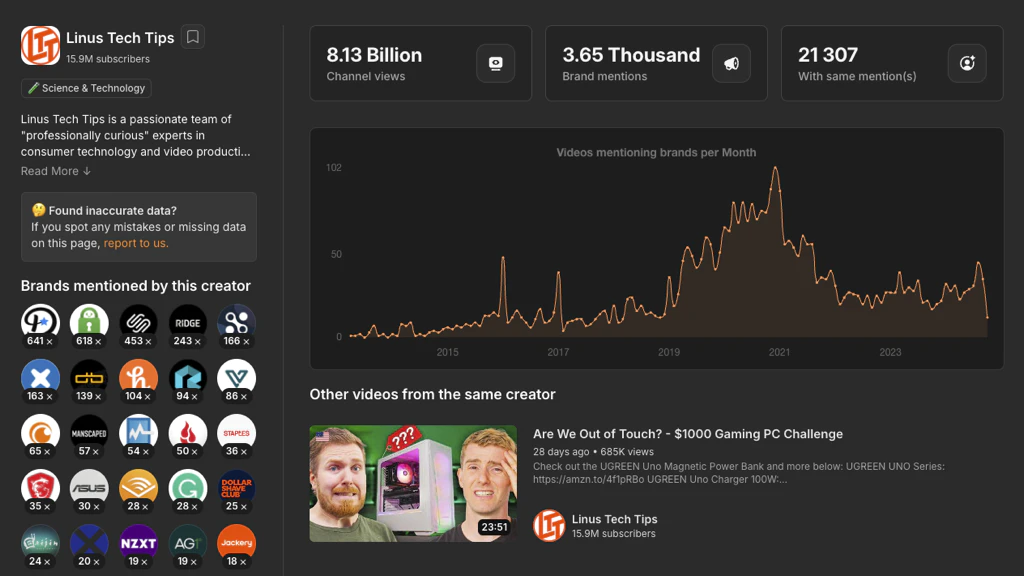
A YouTube influencer search can identify channels by subject. Sponsorship history adds another layer: which brands appeared, how recently, whether they returned, and whether the channel is crowded with competing offers. Review at least five recent videos and several sponsored segments before adding a name to the outreach list.
Use the influencer vetting checklist to record audience geography, typical views, comment quality, content consistency, sponsor conflicts, disclosure behavior, and brand-safety concerns. Do not rank candidates by followers. Rank them by audience fit, product proof, distribution, and commercial terms.
Repeat partnerships can reduce briefing time and improve the content, but creators should earn renewal. Keep the fee, rights, codes, results, and next decision in one place so a good relationship never replaces commercial evidence.
Put the full deal in writing
A clean offer tells the creator exactly what you are buying. Specify the format, integration length, publish window, links, codes, claims, review process, disclosure, reporting, payment, exclusivity, and usage rights. A free influencer brief template can hold the details.
Keep the required message short. Give the creator the product facts and prohibited claims, then let them find the demonstration and language that fit their audience. Review product accuracy, legal claims, and offer terms. Leave the delivery in the creator's voice.
Treat usage rights as a priced deliverable. Organic posting, reposting on brand accounts, embedding on a product page, editing the footage, and running it as paid advertising are different rights. Define the channels, territories, duration, and whether the brand can create derivative edits. If paid amplification is likely, negotiate it before the content performs.
Fulfillment is part of campaign quality. Confirm the address, variant, size, delivery restrictions, and arrival deadline. Keep replacement inventory for damaged or failed deliveries. For perishable products, coordinate the shoot window. A missed parcel can consume the entire content schedule.
Use the smallest tool stack that works
Your first campaign needs three things: reliable store data, a creator shortlist, and one place to track decisions. Sponsorship.so can help you find YouTube creators, inspect sponsor history, estimate fees, and organize outreach. Your store remains the source of truth for orders, refunds, and contribution profit.
Add more software only when a repeated task becomes the bottleneck. A dashboard full of engagement screenshots cannot tell you whether a campaign made money.
Track profit, not clicks
Give each creator a unique landing page or tagged link and, where useful, a memorable code. Test every link, code, currency, mobile page, and purchase event before publication. The discount code generator can help create readable offers; your store remains the system that must enforce and report them.
Build a scorecard with four layers:
- Delivery: content published on time with the agreed placement, claims, disclosure, links, and code.
- Attention: qualified views, retention around the integration, relevant comments, and saves or shares where available.
- Commerce: eligible sessions, new-customer orders, net revenue, refunds, and first-order contribution.
- Durability: repeat-purchase contribution, content shelf life, and the value of approved creative reuse.
Set the attribution and return windows before launch. Affiliate and commission payouts should wait until orders have passed the relevant cancellation and return period. Belkin's public affiliate program is a useful example: its reporting includes orders and shipments, while returned, disputed, or fraudulent orders can be deducted from payout. A reported order can therefore affect later commission reporting. This is closer to the real order lifecycle than a screenshot of checkout revenue.
The broader influencer marketing KPI guide explains CPA, ROI, lift, and attribution in more detail. For online retail, the renewal decision should come back to contribution profit, conversion quality, and customer cohort value. Treat influencer marketing ROI as a program measure, not a single-post vanity score.
Five ecommerce influencer marketing examples
1. Belkin: report the order lifecycle, including refunds
Belkin's official affiliate program accepts websites, blogs, and social channels, supplies trackable links, and reports impressions, clicks, orders, shipments, and commissions. Its terms also address returned, disputed, and fraudulent orders. The lesson is not a particular commission rate. It is the reporting design: evaluate the order and commission after later adjustments, not only at checkout.
That model fits a broad accessories catalog. A retailer can give each tech, gaming, mobile, or home-office influencer a link to the item used in the content instead of one generic storefront. A store operator can copy the principle by reporting net shipped orders and contribution, not only link revenue.
They also sponsor content creators, here is an example of a Belkin sponsorship:
2. Good Ranchers: turn influencer fit into a shoppable product
Good Ranchers maintains an official partners page and sells named partner boxes. Its Michael Knowles box, for example, combines an influencer-selected bundle, dedicated landing page, specific price, and subscription offer.
This makes the endorsement concrete. The influencer is not pointing at an abstract catalog; the audience sees a curated SKU and one offer. The dedicated page can also simplify merchandising and attribution. Because the product is replenishable, the brand can examine repeat-purchase contribution after the first order. No public influencer-level retention or profitability data was found, so those outcomes should be measured rather than assumed.
Here's an example of a YouTube sponsorship from Good Ranchers:
3. DJI: make product output the demonstration
DJI's products create footage, so influencer work can demonstrate the product while producing the marketing asset. Its affiliate program provides trackable links and performance reporting. The company also runs the SkyPixel photo and video contest around work made with DJI products.
For the eleventh contest, DJI's official launch announcement described awards, store credits for entrants, and Creator Contracts for grand-prize winners. Its April 2026 winners announcement reported nearly 95,000 submissions from 96 countries and regions. This is a useful model for a visual product: invite creation, identify skilled product users, reward the best work, and build a pipeline for longer influencer collaborations.
Here's an example of a DJI sponsorship:
4. Back Market: use influencers to reduce category anxiety
Refurbished electronics carry a trust problem. The buyer wants evidence that the device and seller are credible. A TikTok for Business case study says Back Market produced fresh influencer content through TikTok Creative Exchange, then distributed it across paid placements. TikTok reported lifts in ad recall, awareness, and purchase intent. Those are brand-study results, not attributed orders or ROAS.
The cited campaign establishes influencer-made content distributed through paid placements; it does not document an organic influencer test. A useful extension is to separate those two tests. Organic influencer response can test the spokesperson, proof, and hook inside the influencer's audience. Paid amplification can test whether the same creative persuades outside that audience. When negotiating rights, plan for both paths and score them separately.
Here's an example of a Back Market sponsorship:
5. Eight Sleep: match a high-consideration product with credible use
Eight Sleep has used athletes as product users and campaign sponsors. Its official announcement says Danny Green had used the product since 2018, while Charles Leclerc was announced as an athlete ambassador and investor. This is a high-consideration product that benefits from credible use and clear explanation.
A separate Strava challenge case study shows how the brand paired a relevant fitness audience with a specific offer. It is a platform activation, not proof of influencer-level ROI. The transferable principle is to reduce uncertainty: choose a credible user, show the product in context, explain the mechanism, make one clear offer, and provide normal risk reducers such as trial and return terms.
Here's an example of a Eight Sleep sponsorship:
Run a 90-day online retail influencer program
Days 1-15: establish the commercial floor
Choose one product or tight collection. Calculate first-order contribution margin, set a maximum acquisition cost, define the return window, and decide how much repeat purchase you will count. Select one content job: acquire orders, prove a product, or produce reusable creative. Trying to optimize all three in the first test makes the result hard to read.
Days 16-30: shortlist and contract a cohort
Build a list of 20 to 30 influencers, vet the strongest candidates, and contact a manageable group. Select a cohort with comparable audiences or content formats so the test can teach something. Record the fee, product cost, rights, expected publication date, link, code, and decision threshold before signing. This is the stage to sign an influencer only when economics and content proof are both credible.
Days 31-60: publish and monitor
Confirm delivery, test tracking, and watch the content in context. Save screenshots or exports of the platform and store data at consistent checkpoints. Read comments for product objections and buying questions. Fix broken links or codes quickly, but do not rewrite the evaluation criteria after seeing weak results.
Days 61-90: reconcile and decide
Wait for the agreed refund period, calculate influencer contribution, and review the acquired-customer cohort. Renew influencers who combined audience fit, useful content, clean delivery, and acceptable economics. If the post was persuasive but distribution was weak, consider licensing the creative. If reach was high but the product proof failed, a larger influencer is unlikely to repair the offer.
Common ecommerce influencer marketing mistakes
- Using retail value as the cost of gifting. Use landed product cost and fulfillment, then record the opportunity cost separately when inventory is constrained.
- Paying commission on orders that later disappear. Align payout timing with cancellations, fraud, and returns.
- Running a storewide discount without margin controls. Exclude products that cannot carry the offer and monitor code leakage.
- Buying a post without the rights you later need. Organic distribution and paid usage are different deliverables.
- Declaring a winner from clicks. Reconcile net orders, contribution, new-customer quality, and content value.
- Generalizing from one influencer. Test a cohort before deciding that a platform, influencer size, or content format works.
If you sell software rather than physical products, inventory and margin are the wrong operating center. Use the startup influencer marketing playbook for trial, activation, and pipeline measurement. For store operators, pair this guide with solid ecommerce SEO so influencer traffic lands on pages that convert.
Ecommerce influencer marketing FAQ
Does influencer marketing work for ecommerce?
It can work when creators reach a relevant audience, demonstrate the product credibly, and acquire customers below the brand's allowable cost. Evaluate net contribution after discounts, COGS, fulfillment, returns, fees, and commissions. Revenue or engagement alone cannot establish profitability.
How do online retailers find ecommerce influencers?
Start with influencers who teach or demonstrate the product category, influencers whose audience experiences the problem, and channels already sponsored by adjacent brands. Review recent content, typical views, audience geography, comment quality, sponsor history, competing offers, and disclosure behavior before outreach. Many online creators in this space are easier to vet when you inspect sponsor history instead of follower count alone.
Should a brand use gifting, a flat fee, or commission?
Use gifting when product cost is low and posting is optional. Use a flat fee when you need a guaranteed deliverable. Use commission when tracking and margins support it. A hybrid deal gives the creator a production fee while both sides share the upside.
How do you track influencer-generated sales?
Use a unique tagged link or landing page, an influencer code, tested purchase events, and a post-purchase survey. Reconcile orders after cancellations and returns, then compare first-order and later contribution. Keep the attribution rules and windows consistent across influencers.
Are micro-influencers better for ecommerce?
Not by default. Smaller influencers may offer narrow audience fit and lower test costs; larger influencers may provide stronger reach and production. Compare influencers on product relevance, typical qualified views, content quality, commercial terms, and contribution profit rather than assigning a winner by follower tier.
How much should an online retailer pay an influencer?
The acceptable fee is bounded by expected qualified views, content value, rights, and the product's economics. Estimate a market rate, then calculate how many net new-customer orders the all-in cost requires at your contribution margin. If that hurdle is unrealistic, change the scope or decline the deal.
How do you build long-term influencer programs?
Start with a scored cohort test. Renew creators who deliver useful content, acceptable economics, and a smooth working process. Keep fees, codes, rights, results, and renewal decisions in one place so each campaign improves the next one.
When the economics are clear, use Sponsorship.so's ecommerce sponsorship workflow to research YouTube influencers and competitor sponsorship activity. Review plans when you are ready to build and monitor a repeatable influencer list for promoting your ecommerce brand.

Alexandru Golovatenco
Hi, I'm Alex. I write articles about YouTube sponsorships for brands, content creators, and agencies. I also created sponsorship.so, which is a tool that helps you find the right fit for a YouTube sponsorship.