How to Vet Influencers Before Sponsoring Them
Influencer vetting is the process of checking whether an influencer is a good fit for a specific campaign before you agree to a sponsorship. A useful review covers audience fit, recent performance, audience response, sponsor history, disclosure habits, and the influencer’s ability to deliver the work. The same framework applies across YouTube, Instagram, TikTok, Twitch, LinkedIn, and X, although the evidence and metric mix change by platform.
The key is to separate deal-breakers from tradeoffs. Strong influencer partnerships start with evidence. A candidate can have average engagement and still be a strong fit, while a channel with impressive reach can be the wrong partner if its audience is in the wrong market or its past promotions create a conflict.
Use this seven-step process:
- Define the campaign goal and non-negotiable requirements.
- Verify the candidate's audience with first-party analytics.
- Compare performance across a relevant set of recent content.
- Inspect audience engagement and investigate unusual patterns.
- Review sponsor history, category conflicts, and past integrations.
- Run brand-safety, disclosure, and platform-policy checks.
- Confirm commercial terms and use a controlled pilot when evidence is incomplete.
A practical guide to the influencer vetting process
This guide treats partner selection as due diligence: a documented set of criteria used to decide whether a candidate should represent your brand. It is narrower than influencer discovery. Discovery builds a list of possible partners; vetting decides which options are defensible choices for this campaign.
The result should not be a vague label such as “good candidate.” It should help you make informed decisions: shortlist, request more proof, run a pilot, or pass.
Follower count is one input, not the decision. For YouTube sponsorships, average and median views on relevant recent videos usually tell you more about likely reach than the channel's lifetime subscriber count. Audience geography, sponsor history, content format, and viewer response can change the commercial value of two channels with similar headline numbers.
Use two passes: hard stops, then a score

Most reviews put every concern in one long list. That creates bad decisions because a legal risk and a mild creative preference should not carry the same weight.
Start with five hard stops. If any one applies and cannot be resolved, do not let a high score elsewhere rescue the deal:
- Audience mismatch: the candidate cannot show meaningful reach in your target market or customer segment.
- Material brand-safety conflict: recent or repeated conduct conflicts with a written brand standard.
- Unresolved authenticity concern: the candidate will not explain suspicious traffic or provide reasonable first-party evidence.
- Commercial conflict: active competitor exclusivity, category saturation, or another obligation makes the placement ineffective.
- Compliance refusal: the candidate will not follow required disclosure, product-claim, or platform rules.
Then score the candidates who remain. This avoids wasting time debating rates for a partnership that should already be disqualified.
A 100-point creator vetting scorecard
The scorecard below is a starting model, not an industry standard. Change the weights before reviewing your shortlist. An awareness campaign may put more weight on stable reach; a conversion campaign may give more weight to audience fit, brand fit, and relevant sponsor performance.
Criterion |
Weight |
Evidence to review |
|---|---|---|
Audience fit |
25 |
Top geographies, age range, audience interests, active or returning viewers, customer overlap |
Content and sponsor fit |
20 |
Relevant topics, integration style, past sponsors, competitor conflicts, audience response to ads |
Performance consistency |
20 |
Median and average views, outliers, format mix, sponsored versus organic performance |
Engagement quality |
15 |
Comment substance, likes and comments relative to views, repeated accounts, suspicious spikes |
Safety and compliance |
15 |
Archived content, public affiliations, disclosure habits, policy history, product-claim discipline |
Delivery reliability |
5 |
Brief response, schedule, revision process, references, communication, contract acceptance |
Use the result as a decision aid:
- 75-100: shortlist and move to commercial negotiation.
- 60-74: request the missing evidence or run a limited pilot with a defined measurement plan.
- Below 60: pass unless the campaign has a clear reason to accept the weakness.
A score never overrides a hard stop. Keep a short note and a link or screenshot behind every score so a teammate can reproduce the decision.
1. Define influencer marketing campaign goals
Influencer marketing can support goals from awareness and engagement to conversion. Those goals determine what the right influencer looks like: a marketer focused on reach may accept a broad audience, while an ROI-focused campaign needs a tighter target audience. Write a one-page brief before opening a profile. Use the free campaign brief template to define the audience, deliverables, message, and approval process. The broader influencer marketing campaign playbook explains how that brief fits into campaign planning and measurement.
At minimum, name the target customer, target countries, campaign goal, desired content format, budget range, timing, mandatory disclosures, excluded topics, competitor restrictions, and the action you want viewers to take. Decide which requirements are hard stops and which can trade off against reach or price.
For example, a B2B software campaign aimed at US finance teams may require a large share of US viewers and regular coverage of business operations. A broad entertainment channel can have excellent engagement and still be a weak fit. That is not a judgment about the channel; it is a mismatch between the audience and the job.
2. Verify audience fit and brand alignment
Check audience demographics against the people you want to reach. Ask for a dated export or screen recording from the platform's native analytics. A cropped screenshot with no date range is weak evidence because it can hide seasonality, a one-off viral post, or an old audience mix.
For a YouTube channel, request:
- Top audience geographies and languages.
- Age and gender distributions when available and relevant.
- Unique or monthly audience, not only subscribers.
- New, casual, regular, or returning viewer information.
- Traffic sources and the split between Shorts and long-form video.
- Audience-retention or average-view-duration data on comparable videos.
YouTube documents that its Audience reports include top geographies, age and gender information, and returning-viewer data, though some fields can be limited. The YouTube Analytics API also exposes metrics such as average view duration, average view percentage, likes, comments, and shares. Use these fields to test your campaign assumptions rather than asking for every chart in the dashboard.
Check whether the audience evidence matches the profile's public content. If a channel presents itself as US-focused but most watch time comes from markets you cannot serve, lower the audience-fit score. If the mismatch is material to the campaign, stop the review.
How vetting evidence changes by social media platform
Vet the account where the sponsorship will appear, not the person's combined following across every network. Someone can have a strong audience fit on LinkedIn and a much broader audience on TikTok. Treat those as separate placements with separate evidence, pricing, and risk.
Platform |
Evidence to prioritize |
What can mislead you |
|---|---|---|
YouTube |
Median and range of views for comparable formats, audience geography, returning viewers, retention, and sponsored-video performance |
Subscriber totals that include dormant viewers or audiences built through a different format such as Shorts |
Accounts reached, views, saves, shares, top locations, age ranges, and separate results for Reels, Stories, posts, and live video |
Combining results from formats with different reach patterns or treating repeated views as unique reach |
|
TikTok |
Median and range of recent views, watch time, completion, shares, comments, audience information, and results from previous paid posts |
Pricing from one viral post or assuming a follower automatically sees each new video |
Twitch |
Average concurrent viewers, unique viewers, minutes watched, stream frequency, unique chatters, and prior live sponsorship execution |
Peak viewers without stream duration or raid context, and chat volume without reading the conversation |
Impressions, members reached, clicks, substantive comments, and viewer demographics such as job title, industry, seniority, company size, and location |
A large follower total with little overlap with the buyers or professionals the campaign needs |
|
X |
Impressions, engagements, link clicks, replies, reposts, and video retention or completion when video is part of the placement |
High view counts driven by repeated views, controversy, or replies from people outside the target market |
Do not add audiences across platforms as if every follower were a different person, and do not use one universal rate for engagement. No single metric makes accounts on different networks directly comparable. Build a benchmark for the same platform, format, niche, and campaign goal. If a package spans several networks, score each placement separately before deciding whether the combined deal is worth the price.
Sponsorship.so currently focuses its automated sponsorship research on YouTube. For Instagram, TikTok, Twitch, LinkedIn, and X, use the same review framework with native analytics, public content, and manual evidence checks.
3. Compare recent performance without hiding the outliers

Review a relevant sample of recent content, not the creator's three best posts. For a YouTube integration, start with the last 10 to 20 comparable long-form videos and separate Shorts, livestreams, and unrelated formats.
Record the median views, average views, lowest and highest result, upload date, topic, format, and whether the video was sponsored. The median limits the influence of one viral hit. The range shows how much delivery risk you are accepting.
Then compare sponsored and organic videos. Watch several integrations from start to finish:
- Does the creator connect the product to the topic, or read a detached script?
- Is the placement early enough to receive meaningful exposure?
- Do viewers respond with questions, buying intent, indifference, or hostility?
- Does sponsored content perform in the same range as comparable organic videos?
You can use the free YouTube engagement rate calculator as a consistent first pass, but do not turn one rate into a verdict. Compare like with like: similar creator size, niche, format, and time period.
4. Check engagement quality without pretending you can prove fraud
Engagement metrics can surface questions about audience authenticity; they rarely prove why a pattern exists or establish influencer credibility by themselves. YouTube prohibits artificial increases to views, likes, comments, subscribers, and other metrics. It also says its systems may adjust counts and discard low-quality playbacks while confirming engagement.
Look for combinations of signals:
- Sudden follower spikes with no visible content, press, partnership, or viral event that explains them.
- Comments that repeat the same phrasing, arrive in a tight pattern, or do not relate to the video.
- A large subscriber base paired with consistently small viewership across the relevant format.
- Engagement concentrated in the same small set of accounts on every post.
- Large differences between public performance and the first-party analytics supplied by the creator.
None of these proves purchased engagement on its own. Ask the creator for context and supporting analytics. A viral video can explain a subscriber spike. A dormant channel can explain low views relative to subscribers. Document the explanation, then decide whether the remaining uncertainty fits your risk tolerance.
5. Review sponsor history and category conflicts
Past brand partnerships show how a channel handles the work you are about to buy. Review the last six to twelve months and note the brands, categories, integration formats, frequency, disclosure style, and viewer response. These YouTube sponsorship examples show several content styles and brand collaborations worth comparing.
Look for positive signals:
- Repeat sponsors, which can justify asking about renewal performance.
- Products that fit the creator's normal subject matter.
- Integrations that demonstrate the product instead of reading generic claims.
- A manageable sponsorship frequency that leaves room for your message.
Then check conflicts. A creator may have an active exclusivity clause, a recent direct-competitor deal, or so many promotions in one category that viewers no longer distinguish the products.
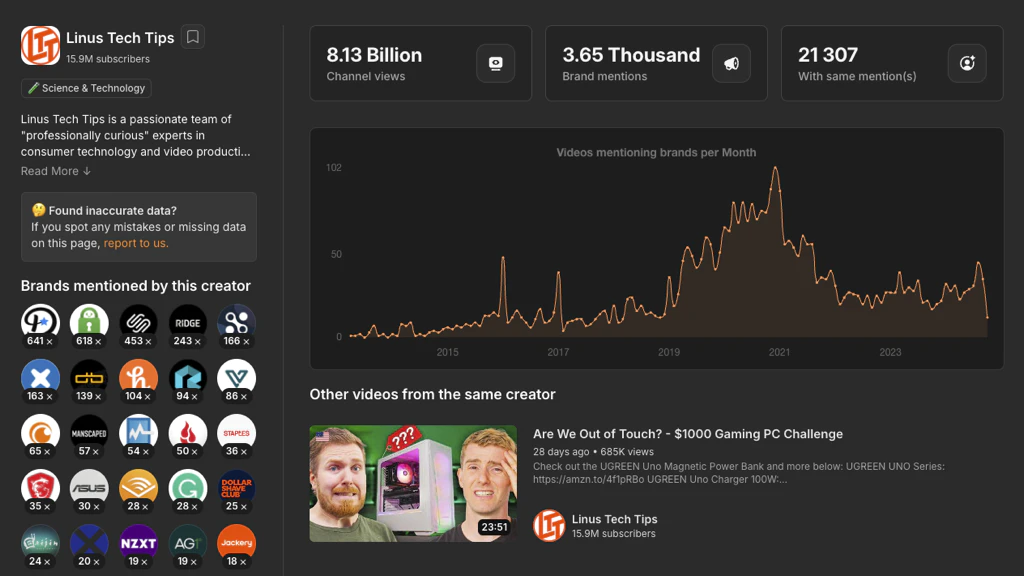
Sponsorship.so tracks YouTube sponsorship activity so you can research which brands a creator has mentioned and compare similar channels. The public top YouTube sponsor categories are also useful for understanding how crowded a niche is before you contact creators.
6. Audit brand safety and compliance
Write your brand-safety rules before the search. “No controversy” is not a usable standard. Name the topics, behaviors, affiliations, claims, brand values, and competitor relationships that require review, and distinguish old isolated mistakes from recent repeated conduct.
A documented brand safety check protects brand reputation by making potential risks reviewable before a campaign goes live. For high-reach or regulated campaigns, record a short reputational risk assessment and the evidence behind it.
Search the creator's current and former handles, public profiles, recent videos, older high-reach content, descriptions, bio links, and relevant news coverage. Read enough context to understand a flagged post. A keyword match is not the same as an endorsement of the idea in the post.
Compliance belongs in the vetting stage because the brand shares the risk. The US Federal Trade Commission says material connections can include payment, free products, discounts, employment, family, or personal relationships. Its guidance says video disclosures should appear in the video and be hard to miss. The FTC's 2023 Endorsement Guides update also warns that a platform's built-in disclosure tool may not be enough on its own.
YouTube separately requires creators to mark videos that contain paid promotions and says creators and brands remain responsible for applicable disclosure laws. Review several previous sponsored videos. If the creator repeatedly hides or omits disclosures, require a written correction plan before proceeding. For regulated products or campaigns aimed at children, get qualified legal review rather than relying on general guidance.
7. Confirm delivery risk and run a pilot when needed
A creator can pass every audience check and still be difficult to work with. Before approving the deal, align on deliverables, timing, creative control, revision rounds, usage rights, paid amplification, exclusivity, disclosure language, tracking links or codes, reporting, cancellation, and what happens if the content misses the brief. The guide to negotiating a YouTube sponsorship covers the commercial conversation in more detail. Use the free influencer contract template to turn the agreed terms into a written starting point, then have qualified counsel review it for your situation.
Ask one or two operational questions before negotiating the final rate:
- What information do you need to make the integration credible for your audience?
- Which recent sponsorship best represents the format you would propose for us?
- What does your normal review and revision process look like?
- Can you share post-campaign results for a relevant past integration, with confidential details removed?
If the fit is promising but the evidence is incomplete, reduce the size of the first commitment. Use one deliverable, a defined attribution method, limited usage rights, and a clear renewal decision. Estimate a defensible budget range with the YouTube sponsorship calculator, then judge the pilot against the agreed goal rather than follower count.
Worked example: vetting a YouTube creator for a SaaS sponsor
Assume a project-management SaaS wants US-based startup teams to begin a trial. A creator has 180,000 subscribers and publishes long-form videos about bootstrapped software businesses.
The creator passes the hard stops: their audience is materially US-based, no unresolved safety issue appears, they provide native analytics, they have no current direct-competitor obligation, and they agree to the required disclosure.
Criterion |
Score |
Reason |
|---|---|---|
Audience fit |
21/25 |
Strong US and startup overlap; limited evidence on team size |
Content and sponsor fit |
18/20 |
The product fits the normal topic and previous software integrations are concrete |
Performance consistency |
14/20 |
Median views are useful, but results vary widely by guest and topic |
Audience engagement |
12/15 |
Comments are specific and relevant; public interaction is moderate |
Safety and compliance |
13/15 |
No material conflict found; previous disclosures are clear |
Delivery reliability |
4/5 |
Clear schedule and revision process; no reference from a prior sponsor |
The total is 82/100, so the creator moves to negotiation. The wide performance range argues for a single-video pilot rather than a multi-video commitment. The contract should define the target landing page, tracking method, disclosure, placement window, and the performance evidence needed for renewal.
This is the point of the scorecard: it preserves the strong fit without hiding the delivery uncertainty.
Potential red flags when you vet influencers
- The creator refuses to share dated native analytics but sends a media kit with unsupported numbers.
- Their audience geography does not match the markets where you can sell.
- Recent sponsored posts receive a materially worse response than comparable organic content.
- The same generic comments appear across unrelated posts.
- They promote direct competitors close together without explaining category restrictions.
- Product claims in prior sponsorships go beyond what the brand could reasonably support.
- Paid partnerships are disclosed inconsistently or only after viewers expand the description.
- The rate is based on subscribers while recent relevant videos deliver far fewer views.
- The creator cannot describe their audience or propose a credible integration angle.
- They resist clear deliverables, measurement, usage-rights, or cancellation language.
A red flag is a reason to investigate, not permission to make an accusation. Record what you found, ask for context, and decide against the standards in your campaign brief.
Interactive creator vetting checklist
- Campaign goal, target customer, market, format, and budget are written down.
- Hard-stop rules are agreed before anyone reviews the creator.
- Audience analytics are dated and come from the native platform.
- Recent comparable content has been reviewed as a set.
- Median, average, range, and sponsored-versus-organic performance are recorded.
- Comments and unusual growth or engagement patterns have been investigated.
- Past sponsors, competitor conflicts, and category saturation are documented.
- Current and archived content has been checked against written safety rules.
- Disclosure and platform-policy requirements are accepted in writing.
- Deliverables, revisions, usage rights, exclusivity, tracking, and cancellation are clear.
- Each score has a source, screenshot, or note.
- The final decision is shortlist, request evidence, pilot, or pass.
Once the process is documented, save approved creators and their evidence so you do not repeat the same work from scratch. The free sponsorship tracking spreadsheet gives you one place to record contacts, fees, deliverables, campaign status, and results. Re-check the high-risk fields before every new campaign.
Common questions about vetting influencers and influencer vetting tools
How do you verify an influencer's authenticity?
Compare public performance with dated first-party analytics, review a relevant set of recent content, and investigate unusual growth or comment patterns. Do not treat a low engagement rate or follower spike as proof of fraud. Ask for context, document the evidence, and judge the remaining uncertainty against your campaign risk.
What analytics should a brand request from an influencer?
Request a dated native report that covers audience geography, age, and gender when relevant, unique reach or audience size, performance for comparable content, and previous sponsored placements. Then add the format-specific evidence: retention for video, Story reach for Instagram, live viewers and chat activity for Twitch, or professional audience attributes for LinkedIn. Ask for enough surrounding interface to identify the platform and reporting period.
How many posts should you review when vetting an influencer?
Review enough comparable content to see the normal range rather than a highlight reel. For YouTube, 10 to 20 recent videos is a practical starting sample. Separate Shorts, livestreams, and long-form videos because each format can have a different audience and performance pattern.
How often should you re-vet influencers?
Re-check a creator before each new campaign or renewal. Audience mix, sponsor conflicts, public content, platform standing, and disclosure habits can change. A lightweight renewal review can focus on changes since the last approval, while higher-risk categories need a deeper fresh review.
Do you need a vetting tool?
You can vet a small shortlist manually with native analytics, public content, search, and a spreadsheet. AI-powered influencer analysis can speed up research and surface concerns, but it cannot replace contextual review. For YouTube campaigns, Sponsorship.so helps you research sponsorship history, compare performance signals, and estimate rates. Other platforms still require native analytics and manual checks. Compare the available plans if YouTube research is becoming the bottleneck.

Alexandru Golovatenco
Hi, I'm Alex. I write articles about YouTube sponsorships for brands, content creators, and agencies. I also created sponsorship.so, which is a tool that helps you find the right fit for a YouTube sponsorship.