Influencer Marketing for Startups - Full Playbook
Influencer marketing for startups means paying trusted niche creators to introduce your product to a specific ideal customer profile (ICP). Start with one audience, one product action, a fixed budget, and a clear rule for stopping or renewing. Your first campaign is a test, not a commitment to build a large program.
Software is harder to promote than a product someone can understand in one glance. The creator may need to explain the problem, show the workflow, and give viewers a reason to try an unfamiliar company. This playbook gives you a 30-day test plan and five examples from Mercury, PostHog, Lovable, Vanta, and Mobbin.
Company question |
Evidence to collect |
Decision |
|---|---|---|
Does this creator reach our ICP? |
Topics, audience demographics, comments, sponsor history |
Shortlist or reject |
Can the product be understood in the content? |
Clear problem, visible workflow, short time to value |
Pick format and message |
Did the sponsorship create qualified demand? |
Qualified signups, demos, activation, pipeline |
Stop, repeat, or revise |
Can the result scale? |
Acquisition cost, retention, content shelf life, operational load |
Renew the creator or expand the cohort |
Why influencer marketing for startups works differently
An early-stage company has little brand recognition and limited room for expensive mistakes. The creator's job is broader than distribution: explain the problem, demonstrate the product, and give the viewer enough confidence to try it. Good startup sponsorships often look more like useful education than a generic promotion.
For a first pilot, prefer relevance over reach. A security practitioner can explain a compliance product to the right buyers. A developer educator can place an analytics tool inside a real workflow. A design newsletter reaches people while they are already doing design work. Follower count matters less when most of the audience will never use the product.
Lean teams should also separate three adjacent programs:
- Paid sponsorship: the company buys a defined placement or deliverable.
- Affiliate: compensation depends partly or entirely on attributed signups or sales.
- Brand ambassadors: customers or advocates participate for access, support, events, visibility, or other benefits, with or without cash compensation.
The label affects influencer contracts and disclosure. The US Federal Trade Commission says commissions, gifts, free product, and other material benefits can require clear disclosure; ordinary product access available to everyone is not the same as special paid access. Use the FTC Endorsement Guides FAQ as the primary reference for US campaigns. On YouTube, creators should also use the platform's paid-promotion declaration when content contains a paid placement, sponsorship, or endorsement.
Make sure the product is ready
Do not sponsor a creator to repair a product that cannot convert a warm visitor. Before you buy a placement, a qualified visitor should be able to understand the promise, start a trial or request a demo, and reach value without the founder rescuing every step.
Use four readiness gates:
- ICP gate: you can name the role, company type, problem, and trigger that make a viewer qualified.
- Proof gate: the creator can show a credible workflow, outcome, or use case without making unsupported claims.
- Conversion gate: the landing page and onboarding path work on mobile and desktop, and the trial, signup, or demo event is recorded.
- Follow-through gate: the team can qualify leads, support new users, and observe activation or pipeline after the click.
If one gate fails, fix it before buying distribution. A sponsor read can send attention; it cannot create a coherent activation experience.

Design a test that can fail
A useful pilot makes a prediction that can be wrong. Avoid goals such as “build brand awareness” unless you have a lift method and enough reach to measure it. For the first campaign, choose the closest observable action that represents real value: an activated workspace, qualified demo, imported project, connected integration, or sales-qualified opportunity. Keep the first cohort isolated until that test produces a decision.
Write the experiment before outreach:
We believe [creator cohort] can reach [ICP]
because their audience already consumes [specific topic].

We will spend no more than [budget] on [number] placements.
Success means [qualified threshold] within [window],
with [activation, retention, or pipeline guardrail].

If the threshold is met, we [repeat or expand].
If it is missed, we [stop or change one variable].
Set a maximum spend and a customer-acquisition ceiling. If the all-in sponsorship costs $3,000 and the company can pay at most $500 for an acquired customer, the campaign needs at least six attributed acquired customers to clear that simple hurdle. This is an illustrative calculation, not a benchmark or proof of incrementality. Your ceiling should come from gross margin, payback, retention, and cash constraints.

A filled pilot example
Consider a hypothetical developer tool. The ICP is an engineering lead at a 20- to 200-person software company. The primary event is a new workspace; activation means connecting a repository and inviting a teammate. The team caps three technical-creator placements at $3,000 total and uses a 30-day attribution window.
- Stop: fewer than three attributed activated workspaces across the cohort.
- Repeat: three to five activated workspaces plus evidence that the audience and demo were a fit.
- Scale: at least six activated workspaces at or below the $500 ceiling, with 30-day retention no worse than the normal acquisition cohort.
Those thresholds are example math, not industry standards. Their value is that the team agrees on the event, window, activation guardrail, and decision before the placements run.
For sales-led products, replace customers with qualified pipeline and use historical funnel data cautiously. A dollar of early-stage pipeline is not a dollar of revenue. Keep demos, qualified opportunities, closed revenue, and retained accounts as separate stages.
Find creators from sponsor history
Start with the media your customers already use: YouTube channels, podcasts, newsletters, LinkedIn creators, X accounts, short-form video educators, and specialist communities. Then inspect sponsorship history. A creator who has worked with adjacent products has shown commercial openness and may already attract buyers in your category.
Build the shortlist in four passes:
- List direct competitors, adjacent tools, and products your ICP buys before or after yours.
- Identify influencers those companies sponsor and record the date, format, topic, and offer.
- Expand to creators who cover the same problems but have not promoted a direct competitor.
- Review recent content and comments to confirm that the audience discusses the problem your product solves.
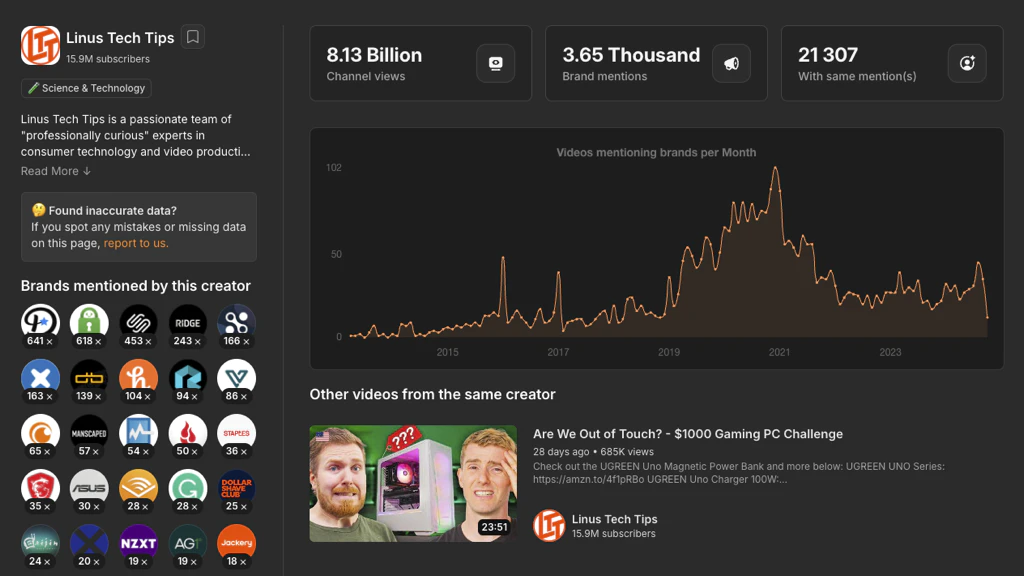
Sponsorship.so is built around this workflow: use the YouTube sponsorship database to inspect brand-creator connections, then use the creator search tool to expand the list by topic. The influencer vetting process helps assess audience fit, typical views, sponsor conflicts, disclosure, and brand safety.
Do not assume that every competitor placement worked. Sponsorship history is discovery data, not proof of ROI. Repeated, recent placements are a stronger signal than one old mention, but the commercial result remains private unless the company or creator publishes it.
Use the smallest operating stack that works
A founder or marketer can run the first pilot with a shortlist, a spreadsheet, and a clear scorecard. Add software when repeated research, outreach, or reporting becomes the bottleneck. Consider an agency only when you need outside strategy or campaign operations that the team cannot own.
Sponsorship.so helps lean teams find YouTube creators, inspect sponsor history, estimate fees, and organize a shortlist. It does not replace audience judgment, contracts, payments, or product analytics. Keep the stack small until the campaign proves repeatable.
Choose the channel by the buying motion
Channel |
Best job for lean teams |
Useful primary event |
|---|---|---|
YouTube |
Visual demo, technical tutorial, comparison, durable education |
Qualified signup or activated trial |
Podcast |
Founder trust, category education, complex B2B narrative |
Dedicated-URL visit or demo request |
Newsletter |
Precise professional niche and direct click path |
Signup, content download, or demo start |
Buyer education, practitioner proof, and named professional reach |
Qualified lead or event registration |
|
TikTok |
Fast product feedback, short demos, creator-led UGC |
Signup or waitlist action |
Product-led growth companies often benefit from a demo channel with a direct trial path. Sales-led companies may need a podcast, newsletter, or professional creator who can teach the problem before asking for a demo. Match the evidence window to the buying motion.
Write outreach creators will answer
Early outreach should come from someone who can make a decision and answer product questions. Show that you know the creator's work, explain why the audience fits, suggest one useful content idea, and state the commercial next step.
Subject: Sponsorship idea for [channel/newsletter]

Hi [name],

Your [specific episode/post] explained [relevant problem] to the exact
people we built [product] for. We help [ICP] [specific outcome].

I would like to sponsor a [format] that shows [concrete workflow],
not a generic feature list. Our pilot budget is [range], and we can
provide a test account plus a short factual brief.

If that fits your audience, could you send your current availability,
rate, and reporting package?

[Name and role]
Ask for availability, format, rate, typical reporting, and audience information. Do not request a free custom concept before confirming budget fit. The full influencer outreach email guide covers subject lines, personalization, follow-ups, and negotiation.
Choose a simple deal
A fixed-fee pilot is the cleanest starting point when the creator must research, test, and produce a useful demonstration. Performance-based or affiliate-only offers transfer most of the risk to the creator and are often weak for new categories, long sales cycles, or products with imperfect attribution.
Deal |
Use it when |
Watch for |
|---|---|---|
Fixed fee |
You need a guaranteed placement and useful product demonstration |
Paying for reach without audience or product fit |
Affiliate |
The signup path is fast, trackable, and valuable enough to support commission |
Underpaying category education and missing assisted signups |
Fee + performance bonus |
Both sides want a production floor and shared upside |
Ambiguous event definitions and payout windows |
Multi-placement pilot |
The product needs repeated explanation or several formats |
Committing before the first placement provides evidence |
Define the deliverable, date, integration length, link or URL, offer, disclosure, product access, review process, payment, usage rights, category exclusivity, and reporting inside the influencer contract. Price exclusivity narrowly. A broad ban on every adjacent product can cost more than the placement and make the deal unattractive.
Use the YouTube sponsorship calculator as a planning input, then negotiate against the actual audience and scope. A market-rate deal can still exceed the experiment budget.
Make the product demo the content
Start with the audience's problem, then show the product doing the work. A strong brief names the customer, trigger, workflow, proof, and next step. It does not force a creator to recite every feature. Match the format to the channel: a tutorial on YouTube, a practitioner post on LinkedIn, or a short vertical demo.
Match the format to the buying motion:
- Developer tool: build, debug, or analyze something on screen.
- Design product: use the reference or workflow inside a real design task.
- Founder finance product: connect the feature to a cash, funding, or operations decision.
- Security or compliance product: teach the risk and show how the workflow changes for the buyer.
- Horizontal SaaS: choose one role and one job instead of presenting the whole platform.
Provide a test account with realistic data where privacy permits, a factual claim sheet, and a direct product contact. Limit review to accuracy, required terms, and prohibited claims. The creator should retain control of the explanation and delivery.
Start with a small, relevant creator cohort
Smaller creators can be easier to test because the rates are usually lower and the audience may be more focused. That does not make them automatic winners. Use one cohort, one offer, one landing page, and one primary metric.
Read comments, inspect recent topics, and review past sponsor segments. A specialist with 8,000 subscribers may be more useful than a generalist with 800,000 when the smaller audience is already trying to solve your problem.
Measure activation, not likes
A lean scorecard should follow the product funnel far enough to answer a budget decision. Use dedicated landing pages, tagged links, promo codes when appropriate, and a “how did you hear about us?” field or survey. No method captures every assisted signup, so keep the evidence consistent and label its limits.
Stage |
Example metric |
Question answered |
|---|---|---|
Attention |
Qualified views, completion, sponsor-segment retention |
Did the right audience receive the explanation? |
Intent |
Website clicks, demo starts, signups |
Did viewers take the offered next step? |
Activation |
Connected data, invited teammate, completed workflow |
Did the signup reach product value? |
Commercial quality |
Qualified opportunity, paid account, retained account |
Did the campaign create useful business? |
Efficiency |
Cost per activated user or qualified opportunity |
Should the company buy the placement again? |
Choose one primary outcome and a few diagnostics. The influencer marketing KPI guide explains how to define targets, windows, and decision rules. Track qualified signups and activation; use views and likes to explain the result, not to declare success.
Five startup sponsorship patterns worth studying
Mercury, PostHog, Lovable, Vanta, and Mobbin show different ways lean software companies use creator marketing. Public sources rarely reveal fees, attribution, or profitability, so the useful lessons are audience fit, content format, offer design, and operating rules—not claimed ROI. Each pattern below is strategy-first; add a YouTube sponsorship embed in Lexxy where noted so readers can see the placement in context.
1. Mercury: keep paid sponsorships separate from advocacy
Mercury buys defined placements in founder media when it needs reach, while Mercury Movement runs as a separate cohort for operators who are genuine fans—not a paid sponsorship program. Score paid reads on placement quality and attributed signups; score ambassadors on participation, feedback, and long-term advocacy. Mixing both in one renewal rule makes it hard to know what to repeat.
2. PostHog: sponsor the next useful developer asset
PostHog's creator work points developers toward useful content—a newsletter, benchmark, template, or technical guide—rather than always sending traffic to the homepage. The product shows up inside media the audience already chose. That fits developer tools where trust comes from teaching the problem before asking for a signup.
3. Lovable: test adjacent audiences with the same visible demo
Lovable runs separate affiliate and creator routes on its partnerships page and uses live product-building as the proof. A visual product with a short time to value can frame the same workflow for a no-code user, founder, marketer, or developer. Keep those cohorts separate in reporting—a broad “AI audience” result will not tell the team which customer or use case to pursue.
4. Vanta: teach security and compliance to practitioners and buyers
Vanta is a security and compliance automation platform. Its creator strategy matches expert-led education to the people who feel audit and security risk: practitioners need credible technical depth; founders and operators need the business case and a clear next step. Dedicated landing URLs and offers make each placement easier to attribute than a generic homepage link. Repetition or exclusivity should follow evidence of fit, not precede it.
5. Mobbin: concentrate spend inside a professional niche
Mobbin sponsors design education because its buyers already look for interface references and workflow inspiration while doing design work. The pattern is narrow distribution: professional product, professional media, and enough credible placements inside the customer's working context to test response before expanding.
Keep campaign management simple
After the first pilot, someone must track deliverables, review drafts, store contracts, and decide who to renew. Start with one owner, one scorecard, one shared folder, and one weekly review.
Do not assume every creator campaign needs immediate paid amplification. Paid social can extend an impactful demo, but it cannot fix weak audience fit. If the organic sponsor segment already fails to produce website clicks or qualified signups, amplifying it usually wastes budget. Renew creators whose content explains the product clearly and produces measurable sales or activated users inside your attribution window.
Set stop, repeat, and scale rules before launch
Use three decisions, each with a defined threshold:
- Stop: the audience was wrong, the content could not explain the product, or qualified signups remained below the floor after the agreed window.
- Repeat: audience and content fit were strong, the primary outcome met the threshold, and the team wants another comparable placement before expanding.
- Scale: several placements or creators produced acceptable activated-user or pipeline economics, and the team can support more volume without weakening onboarding or sales follow-up.
Do not scale from one outlier. Repeat the strongest creator or test a small cohort with similar audience characteristics. Change one major variable at a time: creator, format, offer, landing page, or audience. If all of them change, the next result cannot confirm the first.
A 30-day startup creator sprint
This schedule assumes the selected creators have near-term inventory and a short production cycle. When they do not, use the 30 days to select, contract, brief, and provision the campaign, then start the measurement clock when content publishes.
- Days 1-3: choose the ICP, product action, primary KPI, budget cap, and decision rule.
- Days 4-8: inspect competitor and adjacent-brand sponsorships; build a list of 20 relevant creators.
- Days 9-12: vet the list and contact the strongest 8 to 10 with one concrete content idea.
- Days 13-18: select one to three pilots, agree terms, provision product access, and test tracking.
- Days 19-25: review for factual accuracy and publish when inventory permits; capture delivery and attention data.
- Days 26-30: review early intent and activation if content is live. Record the later checkpoint for pipeline, paid accounts, or retention.
Thirty days is enough to ship and observe early signals, not enough for every B2B sale to close. Keep the original attribution window and schedule the later review rather than forcing a premature success story.
Startup influencer marketing FAQ
Does influencer marketing work for startups?
It can work when a creator reaches a specific ICP, can explain the problem and product credibly, and drives a measurable action such as an activated trial or qualified demo. Start with a capped pilot and predetermined renewal threshold rather than a broad awareness campaign.
How much should a startup spend on influencers?
Spend only enough to test a defined audience and format without threatening cash constraints. Work backward from the maximum acceptable customer or opportunity acquisition cost, then compare that hurdle with the creator's fee, production scope, rights, and expected qualified reach.
Can B2B and SaaS startups use influencer marketing?
Yes. The relevant influencer may be a technical educator, operator, consultant, newsletter writer, podcaster, or practitioner rather than a lifestyle personality. Match the creator to the user or buyer, and measure trials, activation, demos, pipeline, or retained accounts instead of ecommerce orders.
Should a startup use an affiliate or fixed-fee deal?
Use a fixed fee when the creator must research and produce a useful explanation. Use affiliate compensation when the signup path is fast, trackable, and valuable enough to support it. A fixed fee plus performance bonus can protect production effort while sharing upside.
How do startups track creator-driven signups?
Use a dedicated landing page or tagged link, a readable code when relevant, and a self-reported attribution field. Follow the cohort from signup to the product's activation event, then to qualified pipeline, payment, and retention where the buying cycle permits.
When should a startup renew a creator?
Renew when the creator delivered cleanly, reached the intended audience, explained the product well, and met the predetermined qualified-signup or efficiency threshold. If content quality was strong but the offer failed, change the offer before expanding to more creators.
How do startups find relevant influencers?
List direct competitors and adjacent products, inspect which creators they sponsor, then expand to educators who cover the same customer problem. Review recent content, audience roles, comments, typical views, past sponsors, competing offers, and disclosure behavior before outreach.
Selling physical products changes the economics and operations. Use the ecommerce influencer marketing guide for product seeding, fulfillment, returns, contribution margin, and paid creative reuse.
For a founder-run YouTube program, see Sponsorship.so's startup sponsorship workflow. Review plans when you are ready to research creators, track competitor sponsorships, and build a repeatable shortlist.
Alexandru Golovatenco
Hi, I'm Alex. I write articles about YouTube sponsorships for brands, content creators, and agencies. I also created sponsorship.so, which is a tool that helps you find the right fit for a YouTube sponsorship.