What is a YouTube Influencer?
What is a YouTube influencer? A YouTube influencer is a video creator whose content can shape what a specific audience thinks, watches, or buys. The creator usually publishes around a recognizable niche, builds an ongoing relationship with viewers, and may work with brands through sponsorships, product placements, endorsements, or affiliate links. A large subscriber count can help, but it is not the definition.
The useful question is not “How many subscribers make someone an influencer?” It is “Can this creator reliably reach and affect the people we care about?” A focused channel with a modest audience may have more commercial influence in its niche than a much larger general-interest channel.
What is the difference between a YouTuber and an influencer?

A YouTuber is anyone who regularly creates videos for a YouTube channel. A YouTube influencer is a YouTuber whose audience relationship gives their opinions, demonstrations, or recommendations weight.
The terms overlap, but they are not identical. A creator can publish entertaining videos without trying to affect purchasing decisions. They become relevant to influencer marketing when a brand can make a credible case that the creator reaches the right audience and can present a product in a useful, believable context.
Influence does not begin with a paid campaign. A software educator who changes which tools viewers try, a gaming creator who drives interest in a new release, and a home-improvement channel whose tutorials shape product choices can all influence their audiences before accepting a sponsorship.
What does a YouTube influencer make?
A YouTube influencer makes video content for a defined audience. Depending on the channel, that output can include long-form YouTube videos, Shorts, livestreams, tutorials, reviews, comparisons, documentaries, commentary, interviews, or entertainment. The creator maintains the audience through consistent topics, recognizable formats, and interaction.
“Make” can also mean income. YouTubers may earn money from YouTube's platform features, brand sponsorships, affiliate sales, or products. There is no fixed income per video or subscriber; the payment methods are explained in the section on how YouTube influencers get paid.
When a brand is involved, the creator may produce an integrated ad read, a dedicated video, a product placement, or an endorsement. YouTube distinguishes these commercial formats in its guidance on paid product placements, sponsorships, and endorsements. The format matters because a brief mention inside a broader video is a different deliverable from an entire review or tutorial.
Some eligible YouTube Partner Program creators can also be discovered by brands through YouTube Creator Partnerships. Access and features vary by country or region. This is one route to a brand deal, not a requirement for being considered an influencer.
Example: Marques Brownlee compares Fitbit Air, Whoop, and Apple Watch
Marques Brownlee's video “The Truth About the ‘Whoop Killer’” is a practical example of a YouTube influencer shaping a buying decision in the wearable market. Instead of reviewing Fitbit Air in isolation, Brownlee compares it with Whoop and uses the Apple Watch as another familiar reference point. That context helps viewers place a new product inside a category they may already understand.
This is where content creation becomes influence. A viewer may arrive asking whether Fitbit Air is a cheaper Whoop, whether Whoop's deeper recovery features justify its cost, or whether an Apple Watch already covers enough of the same job. The video organizes those questions into tradeoffs that a prospective buyer can use. It does not need to issue the same verdict for every viewer to affect what they consider or eventually purchase.
The example also fits the Relevance-Reach-Response-Risk framework used later in this article:
- Relevance: Brownlee creates consumer-technology content for viewers who are likely to research a wearable before buying one.
- Reach: The comparison is published on an established technology channel rather than introduced to an unrelated audience.
- Response: The video answers a high-intent consumer question by comparing practical differences, not only repeating launch claims.
- Risk: Showing strengths, limitations, and tradeoffs gives viewers more decision context than an uncritical product mention.
A brand evaluating a YouTube influencer should look for this kind of fit. The creator understands the category, the audience recognizes the problem, and the content gives viewers useful criteria for deciding. The influence comes from helping the target audience make a choice, not from placing a product on screen.
What are the different types of YouTube influencers?
Marketers often group influencers by subscriber count. The labels are useful for planning, but they are not official YouTube categories and published boundaries vary. Use the following as working bands, then evaluate the actual channel rather than the label.
Working label |
Subscriber range |
What to check |
|---|---|---|
Nano or emerging |
Under 10,000 |
Topic specificity, recent view consistency, audience conversation, and willingness to test a first partnership. |
Micro |
10,000-100,000 |
Audience fit, normal views across several videos, production reliability, and prior sponsor handling. |
Mid-tier |
100,000-500,000 |
Reach by content format, audience geography, category conflicts, rates, and campaign measurement. |
Macro or mega |
500,000+ |
Incremental reach, broad versus niche audience fit, approval timelines, usage rights, and budget concentration. |
These bands describe potential scale, not quality. Two channels with 50,000 subscribers can have different current reach, audiences, and commercial value. YouTube reports monthly audience as estimated unique viewers over the previous 28 days. That active-audience measure often tells you more about current reach than a lifetime subscriber total.
Who are the top YouTube influencers?
There is no single useful ranking of the top YouTube influencers. “Top” can mean the most subscribers, the most recent views, the strongest influence in a niche, or the best match for a target audience. Those measures produce different lists.
As of July 2026, MrBeast is the clearest example of a mass-reach entertainment creator; Forbes placed him prominently in its 2025 Top Creators coverage. In consumer technology, Marques Brownlee, known as MKBHD, is a prominent product reviewer; Axios highlighted his influence on technology purchasing decisions in April 2026.
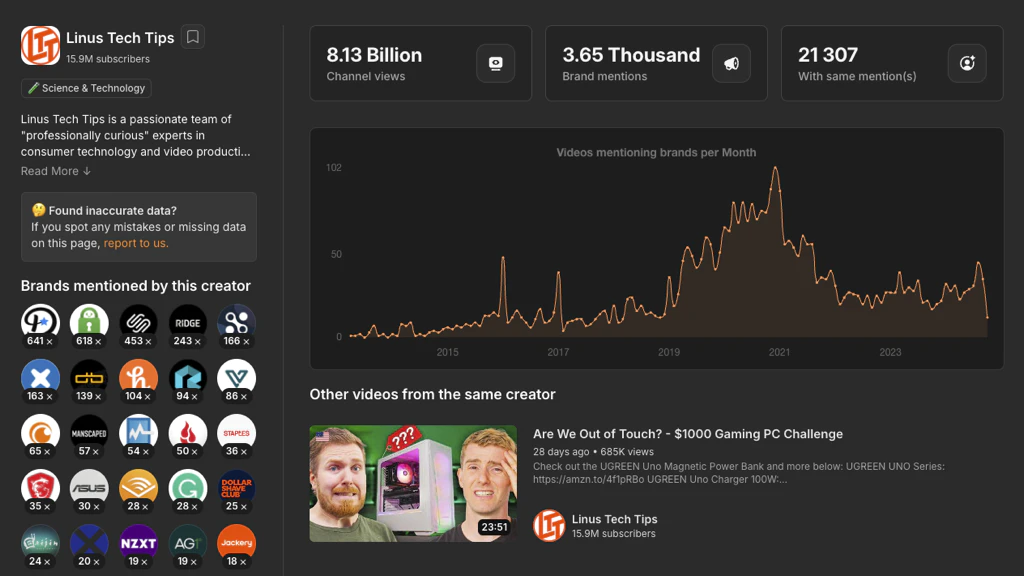
Those names are examples, not a brand shortlist. A finance company, gaming studio, or skincare brand will each have a different “top” creator. Sponsorship.so's top YouTube influencers by sponsor niche ranks channels using detected sponsorship activity, so you can start with creators who already make relevant commercial content rather than a generic celebrity list.
How do you evaluate a YouTube influencer?
Use a Relevance-Reach-Response-Risk review before discussing price. The four parts stop a large subscriber number from hiding a poor fit.
Question |
Evidence to review |
Failure signal |
|---|---|---|
Relevance: Is this the right audience? |
Channel niche, recurring topics, audience geography, viewer interests, and whether the creator's target audience matches the people the product serves. |
The channel is large, but the likely buyers are a small or unnatural part of its audience. |
Reach: How many relevant people are likely to see the video? |
Recent median views by format, monthly audience, unique viewers, returning viewers, and performance over several uploads. |
The estimate depends on subscriber count or one viral outlier. |
Response: Does the audience pay attention and act? |
Watch time, comments, likes, link clicks, discount-code use, conversions, and the quality of discussion around relevant videos. |
Surface engagement looks high, but comments are generic or the creator cannot explain prior campaign outcomes. |
Risk: Is the partnership safe and credible? |
Past sponsors, category conflicts, disclosure habits, content history, suspicious growth, and the creator's process for approvals and claims. |
Undisclosed promotions, conflicting sponsors, artificial engagement, or a mismatch between the creator's content and the brand's standards. |
YouTube Analytics can show information such as audience geography, age, gender, returning viewers, watch time, and unique viewers, although some reports may be limited. Ask the creator for current screenshots or a YouTube media kit when those details matter to the campaign.
Public data still gives you a useful first pass. Use the YouTube influencer search tool to find YouTubers by topic, then compare recent videos and sponsorship history. For a deeper check, follow the full influencer vetting process before signing a deal.
How many subscribers do you need to be a YouTube influencer?
There is no useful universal minimum. “YouTube influencer” is a descriptive marketing term, not a channel status awarded at a fixed subscriber count. A small specialist channel can influence a narrow buying decision, while a larger entertainment channel may offer broad awareness without strong product relevance.
For sponsorship planning, replace the threshold question with three checks: Does the creator reach your buyers? Do recent videos get enough qualified attention for the campaign goal? Is there evidence that viewers respond? The YouTube engagement rate calculator can support that review, but read the comments and watch the content as well.
How do YouTube influencers get paid?
YouTube influencers can get paid through platform revenue and business revenue. Eligible creators in the YouTube Partner Program may earn from ads, YouTube Premium, channel memberships, Super Chat, Super Stickers, Super Thanks, and Shopping. Each feature has its own eligibility requirements.
Creators can also earn through sponsorship fees, product placements, affiliate commissions, or products they sell. YouTube's RPM guidance notes that the RPM shown in YouTube Analytics excludes most brand deals, sponsorships, merchandise, and indirect revenue. That is why a creator's total business income cannot be estimated from public video views alone.
How many views on YouTube do you need to make $2,000 a month?
There is no fixed number of views that guarantees $2,000 per month. Use the channel's actual RPM, which YouTube defines as revenue earned per 1,000 video views after its revenue share. The calculation is:
Required monthly views = ($2,000 / channel RPM) × 1,000
At a $2 RPM, the calculation gives 1,000,000 monthly views. At a $5 RPM, it gives 400,000 views. At a $10 RPM, it gives 200,000 views. These are arithmetic examples, not promised RPM benchmarks. A creator should use the RPM in their own YouTube Analytics because audience location, video format, monetization, season, and revenue mix change the result.
RPM includes several revenue sources reported inside YouTube Analytics, so isolate the relevant source if you only want to estimate ad revenue. Sponsorship income needs a separate calculation because most brand deals are not included in RPM.
How can you become a YouTube influencer?
To become a YouTube influencer, create content for a specific target audience and earn enough repeat attention that your recommendations carry weight. You do not need to begin with a sponsor or a large subscriber count.
- Choose a clear audience and subject. Define who each YouTube video helps or entertains and why they would return.
- Create content in a repeatable format. Pick a format you can sustain, such as reviews, tutorials, commentary, interviews, or entertainment.
- Improve from audience evidence. Use views, watch time, returning viewers, comments, and audience reports to see what earns attention.
- Build trust before monetizing it. Give honest opinions, correct errors, avoid fake engagement, and keep paid recommendations clearly disclosed.
- Prepare for commercial work. Add a business email, document audience and performance data, and define which sponsorship formats fit your content creation process.
Content creation becomes influence when viewers repeatedly use it to make decisions. Subscriber growth can expand that influence, but consistency, audience relevance, and credible recommendations are the foundation.
Do YouTube influencers have to disclose sponsorships?
Creators and brands must follow the rules that apply to their audience and location. In the United States, the Federal Trade Commission says creators should disclose a material connection to a brand, including payment, employment, personal or family relationships, and free or discounted products or services.
For a video endorsement, the FTC says the disclosure should appear in the video rather than only in the description. YouTube also asks creators to identify content that contains paid promotion so the platform can show its disclosure. A platform label does not remove the need to follow applicable advertising law.
Brands should also look for credible audience activity. YouTube's fake engagement policy prohibits artificially increasing views, likes, comments, or other metrics. Sudden unexplained growth or repetitive comments deserve investigation; they are not proof by themselves.
How can a brand work with a YouTube influencer?
Start with the target audience and campaign goal, not a list of famous channels. Decide whether you need qualified reach, demonstrations, reviews, sales, reusable creator content, or repeated exposure. Then find creators whose normal subject matter makes the product relevant.
A practical sequence is:
- Define the audience, market, campaign goal, and acceptable content categories.
- Build a shortlist with the YouTube creator directories or a topic-based search.
- Apply the Relevance-Reach-Response-Risk review to each channel.
- Agree on the deliverable, creative boundaries, disclosure, usage rights, timing, and measurement.
- Estimate a budget with the YouTube sponsorship calculator, then negotiate against the actual scope.
The strongest candidate is rarely “the biggest creator we can afford.” It is the creator whose audience, content, and commercial process fit the job with the least guesswork. Our YouTube influencer marketing guide covers the full campaign after this initial definition and selection step.
YouTube influencer FAQ
Is every YouTuber an influencer?
No. A YouTuber creates videos for YouTube. The label “influencer” is useful when that creator has a recognizable audience and evidence that their content can affect attention, opinions, or actions. The distinction is about the audience relationship, not whether the channel has accepted a sponsorship.
Is being a YouTube influencer a job?
It can be paid work. Eligible creators in the YouTube Partner Program may earn through ads, YouTube Premium, memberships, fan-funding features, and Shopping. Sponsorships are another possible revenue source. Each platform feature has its own eligibility rules, and earning money is separate from the basic definition of an influencer.
What is the difference between a YouTube influencer and a content creator?
“Content creator” describes the work: producing videos or other media. “Influencer” describes the effect of the creator's relationship with an audience. One person can be both. For brand selection, “creator” is the broader label and “influencer” signals potential marketing impact.
What makes a good YouTube influencer for a brand?
A good candidate reaches the right audience, earns consistent attention, generates credible responses, and presents manageable commercial risk. Recent performance across several videos matters more than one viral upload. Clear communication, honest disclosures, and a natural product fit make the partnership easier to evaluate.
When you are ready to move from definition to research, compare channels, past sponsors, and pricing from the Sponsorship.so YouTube influencer database.

Alexandru Golovatenco
Hi, I'm Alex. I write articles about YouTube sponsorships for brands, content creators, and agencies. I also created sponsorship.so, which is a tool that helps you find the right fit for a YouTube sponsorship.