Sponsorship Proposal Examples: What Good Creator Pitches Include
Good sponsorship proposals answer five questions for a brand: Is this audience a fit? Is the performance credible? What exactly is the creator offering? What are the commercial terms? What should the brand do next? The strongest creator pitches make those answers easy to find. They do not rely on follower count, polished design, or enthusiasm alone.
The six public sponsorship proposal examples below are useful because they expose different parts of that buying case. Some are media kits rather than complete proposals. One is a creator's unsuccessful first draft. We have labeled those limits instead of pretending every public deck is a proven winner.
Six sponsorship proposal examples, annotated
Read these examples as source material: keep the decision-helping parts and fix the gaps before sending your own proposal.
Public example |
What it does well |
What a full creator proposal still needs |
|---|---|---|
Names the product fit, a video idea, recent channel views, and the audience's main country. |
A defined deliverable, timing, commercial ask, and a more concrete next step. The creator later reported that this version did not work. |
|
Combines channel analytics, audience demographics, previous sponsors, fixed ad formats, prices, and a bundle discount on one page. |
A brand-specific concept, timing, usage rights, exclusivity, revisions, and a visible last-updated date. |
|
Uses YouTube's first-party report to show 28-day reach, watch behavior, demographics, interests, videos, and contact details. The PDF is dated August 27, 2025. |
A brand-specific campaign idea, deliverables, rates or quote process, rights, and campaign measurement. |
|
Shows current-period performance, audience geography and interests, returning viewers, paid-placement examples, and featured content. |
The sponsor's problem, a concrete integration concept, package scope, price, rights, and next step. |
|
States a narrow audience, reach, geography, engagement signals, creator credentials, and a clear preference for cross-promotion over paid product mentions. |
A proposed exchange for one specific partner, deliverables, schedule, approval process, and reporting plan. |
|
Defines the people a partner can reach, the in-kind exchange, promotional placements, discounted services, event access, and a direct contact. |
Quantitative audience proof, a partner-specific activation, measurement, and tighter boundaries around what each party supplies. |
The pattern is consistent. Creator media kits are often strong on fit and proof but weak on the specific offer and commercial terms. Partnership decks often describe the offer well but provide less audience evidence. A good proposal joins both sides.
What good creator sponsorship pitches include
Use this five-question test before sending a deck, document, or email. Each section should help a brand make a decision, not merely learn more about you.
Brand question |
Evidence to include |
Weak substitute |
|---|---|---|
1. Fit: Does this creator reach people we want? |
Niche, audience problem, top locations, relevant demographics or interests, and why the product belongs in the content. |
Follower count and a generic statement about loving the brand. |
2. Proof: Can we trust the attention? |
Recent typical views or reach, watch time or retention where relevant, comparable content, and shareable past results. |
One viral post with no date, sample, or relationship to the proposed content. |
3. Offer: What are we buying? |
A specific campaign idea, platform, format, placement, length, quantity, publishing window, and included production. |
“Let's collaborate” with no concept or deliverable. |
4. Terms: What changes the price or risk? |
Fee or quote process, payment schedule, revisions, usage rights, paid amplification, exclusivity, cancellation, and reporting. |
One unexplained package price that appears to include every possible right. |
5. Next step: How does this move forward? |
One request: confirm interest, share the brief and budget, choose a package, or book a short call by a useful date. |
“Let me know what you think” with no decision to make. |
This framework extends the media kit's role. The kit proves who you are and who you reach. The proposal turns that proof into a scoped buying decision.
The sections of a creator sponsorship proposal
1. A brand-specific opening
Open with the fit, not your biography. Name the product, campaign, or customer problem and connect it to a recurring audience interest. YouTube's own brand-deal guidance recommends explaining why you like the brand, describing your channel and audience, adding performance and demographic data, and suggesting video ideas.
Brand affinity helps, but it is not the argument. “I use your keyboard” becomes useful when followed by the content moment, audience need, and deliverable that make the product relevant.
2. Audience and creator fit
Choose the audience details that affect this sponsor's decision. A finance app may care about age, geography, and investing interests. A game publisher may care about platform, genres, and the share of viewers in launch markets. Label the platform and date range. Do not merge unrelated audiences into a larger total.
3. Recent performance proof
Show normal recent performance rather than relying on lifetime totals. Use a median or average across a stated sample, such as the last ten comparable videos, and identify unusual outliers. Link two or three pieces that resemble the proposed integration.
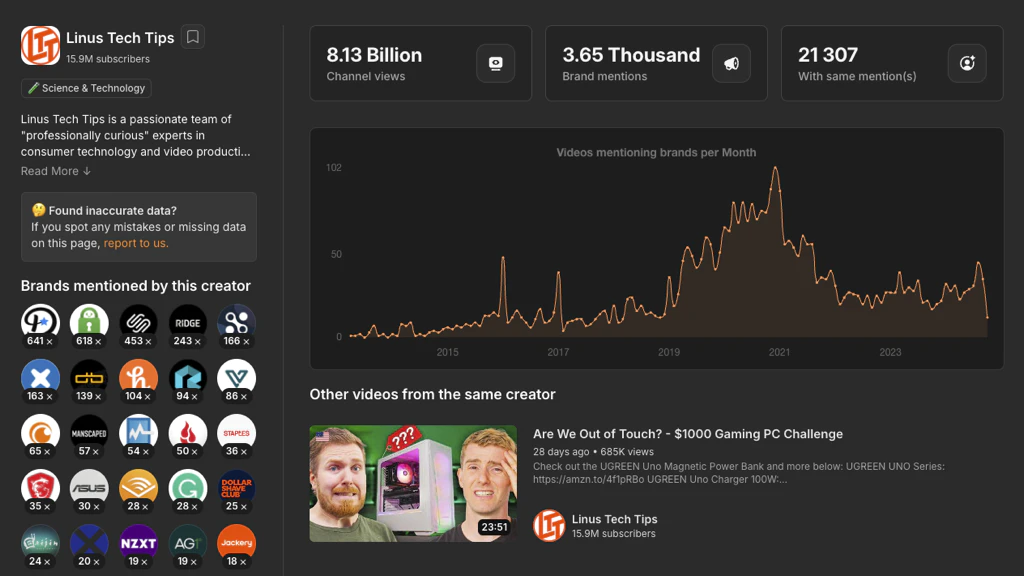
YouTube's generated Media Kit can supply channel statistics, demographics, audience categories, paid-placement videos, and top videos. Treat it as the evidence layer. Add the campaign-specific commercial offer yourself.
4. Campaign concept and deliverables
Give the marketer something they can repeat internally. State the working concept in one sentence, then list the deliverables precisely: one 60-second mid-roll in a long-form YouTube video, one Short, two story frames, or three edited UGC assets. Include the publishing window and the creative role each asset plays.
5. Price and commercial boundaries
A rate without scope is not a usable quote. Separate the creator's publication fee from usage rights, paid amplification, category exclusivity, extra revisions, raw files, cutdowns, rush delivery, and renewal periods when those apply. Use the influencer rate calculator as a planning input, then quote the actual scope.
If you do not have enough information to price the work, state the inputs you need: deliverables, platforms, usage, exclusivity, timeline, budget range, and reporting requirements. That is more professional than guessing.
6. Measurement and reporting
Promise the report you can deliver, not an outcome you cannot control. Depending on the campaign, that may include views after 7 and 30 days, watch time, retention around the integration, clicks, code uses, conversions supplied by the brand, comments, or asset delivery status. Define who owns the tracking links and when the report will arrive.
7. One next step
End with one request. Ask the brand to confirm the concept, send its brief and budget, select a package, or schedule a short scoping call. Include the business email and the person responsible for contracts. A proposal should reduce the number of follow-up questions, not create another vague conversation.
Five copyable creator sponsorship proposal examples
These are original, fill-in-the-blank examples built from the five-question test. They are not transcripts of private deals and do not promise a response. Replace every bracket with true, current information.
1. One-off YouTube integration
Subject: [Brand] integration idea for [Channel]

Hi [Name],

I run [Channel], where [audience description] comes for [recurring topic/problem]. [Brand/Product] fits an upcoming video about [specific topic] because [one concrete connection].

Across my last [sample] comparable videos, the median result was [views] views in [period], with [relevant geography/demographic/retention fact]. Examples: [link] and [link].

Proposal: one [length]-second [pre-roll/mid-roll] integration in a [video format] publishing during [window]. I would demonstrate [product use] and connect it to [audience benefit]. The base fee is [price] and includes [deliverables and revision count]. [Usage/exclusivity] is quoted separately.

If the concept fits, send your brief, target market, usage needs, and budget range by [date]. I can return a final scope within [time].

[Name]
[Business email] | [Media kit]
2. Small creator with a narrow audience
Subject: [Specific content idea] for [Brand]

Hi [Name],

I create [niche] content for [precise audience]. My channel is smaller at [subscribers/followers], but my last [sample] posts about [relevant topic] reached a typical [views/reach] and drew questions about [problem the product solves].

I would like to produce [one defined asset] showing [specific, honest use case]. The proposal is [paid fee / gifted product plus fee / product-only test], with [publication commitment or no guaranteed publication] stated clearly. It includes [deliverables], [revision count], and a [reporting period] report. Paid usage and category exclusivity are not included.

If you are testing creators in [niche/market], may I send a one-page scope and two relevant examples?

[Name]
[Channel link] | [Business email]
3. Three-video sponsorship package
Subject: Three-part [Brand] series for [audience]

Hi [Name],

[Audience] usually needs more than one mention to understand [product category/problem]. I propose a three-video sequence on [Channel]:

1. [Video one]: introduce [problem and product role].
2. [Video two]: demonstrate [use case or workflow].
3. [Video three]: answer [common objection/question].

Each video includes [placement and length], publishing between [dates]. The package fee is [price] and includes [deliverables], [revisions], campaign links, and a report [timing]. Optional [Short/newsletter/community post] costs [price]. Paid usage, exclusivity, and extensions beyond [term] require separate approval.

Recent comparable videos: [links and typical performance]. Audience fit: [two relevant facts].

If this sequence matches your campaign goal, choose [intro only / full series] or send the brief and budget for a revised scope.
4. UGC production with usage rights
Subject: UGC concept and usage quote for [Brand]

Hi [Name],

I produce [style] product content for [audience/context]. For [Brand], I would create [number] vertical videos built around [hook/use case], delivered as [length and format]. Portfolio: [links].

Production fee: [price]. Includes [concepts], [number] edited assets, [revision count], and delivery by [date].

Usage: [organic brand channels] for [term] is [included/price]. Paid media usage for [term and territory] is [price]. Raw footage, cutdowns, whitelisting/Partnership Ads, category exclusivity, and renewals are separate.

The assets would be delivered for approval; publication on my own channels is [included/not included]. Reporting covers [asset delivery or creator-channel metrics, as applicable].

Please confirm intended channels, paid-media term, territory, and launch date so I can issue the final scope.
5. Agency or multi-creator proposal
Subject: [Campaign] creator shortlist and activation plan

Hi [Name],

We propose [number] creators across [niches/platforms] for [campaign objective]. The shortlist is based on [audience fit criteria], recent typical performance, content quality, and category conflicts.

Campaign concept: [one sentence]. Deliverables: [creator-by-creator inventory]. Publishing window: [dates]. Total creator and management budget: [price or range]. The scope includes [contracting, briefing, approvals, tracking, reporting] and excludes [paid usage, exclusivity, travel, product costs, or other items].

Success will be reported through [views/reach], [engagement or retention], [clicks/codes/conversions if supplied], and delivery status at [timing]. We will not guarantee results outside the contracted deliverables.

Next step: approve the selection criteria and budget by [date]. We will then return the named creator shortlist, availability, conflicts, and final fees.
If you want a longer business document, start with the free sponsorship proposal template. For a shorter first contact, use the influencer pitch template.
Media kit vs. sponsorship proposal vs. pitch email
Asset |
Question it answers |
Best use |
|---|---|---|
Pitch email |
Is this idea worth a reply? |
First contact. Keep the fit, idea, proof, and next step in the message. |
Media kit |
Is this creator credible and relevant? |
Reusable evidence: audience, performance, examples, and contact details. |
Sponsorship proposal |
Should we approve this defined partnership? |
Specific concept, deliverables, price, rights, timeline, reporting, and next step. |
Rate card |
What does a standard deliverable start at? |
Qualification when formats are repeatable. It does not replace a scoped quote. |
A cold email usually should not carry a long deck unless the brand asks for it. Lead with the idea and make the proof easy to inspect. The creator outreach guide covers the contact and follow-up workflow around the proposal.
Creator sponsorship proposal checklist
- The brand and recipient are named correctly.
- The opening explains audience-product fit in one short paragraph.
- Performance figures show a date range and a defensible sample.
- Relevant content examples link to the original posts or videos.
- The campaign idea is specific enough to picture.
- Every deliverable has a platform, format, quantity, placement, and timing.
- The fee states what is included and excluded.
- Usage rights, paid amplification, exclusivity, revisions, and renewals are explicit.
- Reporting metrics and delivery dates are defined.
- The final line asks for one decision.
Common sponsorship proposal mistakes
Sending the same “I love your brand” paragraph to everyone
Affinity is easy to claim. Show the content moment, audience need, or buying context that makes the fit credible. If you cannot explain that connection, research a better sponsor before polishing the deck. Creators can use Sponsorship.so's creator workflow to find brands already active around comparable YouTube channels.
Using follower count as the entire proof section
Follower count does not describe current attention. Add typical recent views or reach, the sample behind the number, relevant audience data, and comparable content. Do not hide a small channel. Make its audience specificity legible.
Bundling rights into an undefined price
Publishing once on your channel is different from letting a brand run the content as an ad for a year. State the term, territory, channels, amplification, editing rights, and renewal rules. Our guide to influencer whitelisting and paid usage rights explains the distinction.
Guaranteeing reach, sales, or ROI
You can commit to production, publication, tracking setup, and reporting. You usually cannot guarantee platform distribution or customer behavior. Use historical ranges as evidence, label projections as estimates, and keep guarantees out unless the contract deliberately prices and defines them.
Forgetting disclosure responsibilities
A proposal is not the disclosure. The U.S. Federal Trade Commission says a material connection can include payment, free products, discounts, employment, or personal relationships, and that the disclosure should appear with the endorsement where people can notice it. Review the FTC's current guidance and any rules that apply in your audience's market.
Sponsorship proposal FAQ
How do you write a sponsorship proposal?
Start with the brand-audience fit, add current performance proof, describe one specific campaign concept, list the deliverables and timeline, define price and rights, explain reporting, and end with one next step. Use a media kit for reusable evidence and keep the proposal specific to the brand and campaign.
What are the 10 elements of a successful sponsorship proposal?
Use these ten elements: brand-specific opening, creator positioning, audience profile, recent performance, relevant examples, campaign concept, deliverables, timeline, commercial terms, and a clear next step. Add measurement and reporting inside the deliverables or terms section. Success still depends on fit, budget, timing, and execution.
How do you write a sponsorship prospectus?
A prospectus is useful when several sponsors can buy from the same inventory, such as a recurring show, event, or creator series. Explain the property and audience, show proof, list packages in a comparison table, define availability and terms, and give one contact path. For a single brand, tailor a proposal instead.
Who typically writes a creator sponsorship proposal?
An independent creator, manager, agent, or creator agency can write it. The author matters less than access to accurate analytics, creative scope, rates, rights, conflicts, and availability. The creator should approve any claims and commercial commitments made in their name.
Should a sponsorship proposal include rates?
Include a fee when the scope is defined. If usage, exclusivity, deliverables, timeline, or budget are still unknown, include the quote process and the information needed to price the work. A proposal without any commercial path forces the brand to guess whether the opportunity is viable.
Alexandru Golovatenco
Hi, I'm Alex. I write articles about YouTube sponsorships for brands, content creators, and agencies. I also created sponsorship.so, which is a tool that helps you find the right fit for a YouTube sponsorship.